
Your Road Trip Medical Kit: What to Pack Before You Hit the Highway
When most people pack for a road trip, they think snacks, playlists, and maybe a pillow for the backseat. The more preparedness-minded might toss a first aid kit in the glove box—a small plastic box with bandaids, aspirin, and some antiseptic wipes.
But if your idea of a “first aid kit” ends there, this article is going to challenge that thinking.
Because when something really goes wrong—like a car crash in the middle of nowhere—you’re not going to be reaching for a bandaid. You’re going to need the tools that could keep someone alive long enough for help to arrive.
🚨 The Need: Accidents Happen, Help May Not Be Close
Every year in the U.S., over 42,000 people die in car accidents, and 2.38 million are injured. These aren’t minor fender benders. We're talking high-speed rollovers, head-on collisions, ejections—incidents that create life-threatening trauma in a matter of seconds.
And while most of us imagine help arriving quickly, the reality—especially for road trips—isn’t always that simple:
- Half of all traffic deaths occur on rural roads, where speed is high, and the nearest ambulance may be 30+ minutes away.
- In rural America, EMS response times average 13–19 minutes. Compare that to the 1–3 minutes it takes for someone to bleed out from a severed artery.
- Cell phone dead zones are real. Whether you're driving through national parks, mountain passes, or desert stretches, you may not be able to call 911 at all.
Bottom line: If something happens out there, you may be the only help available.
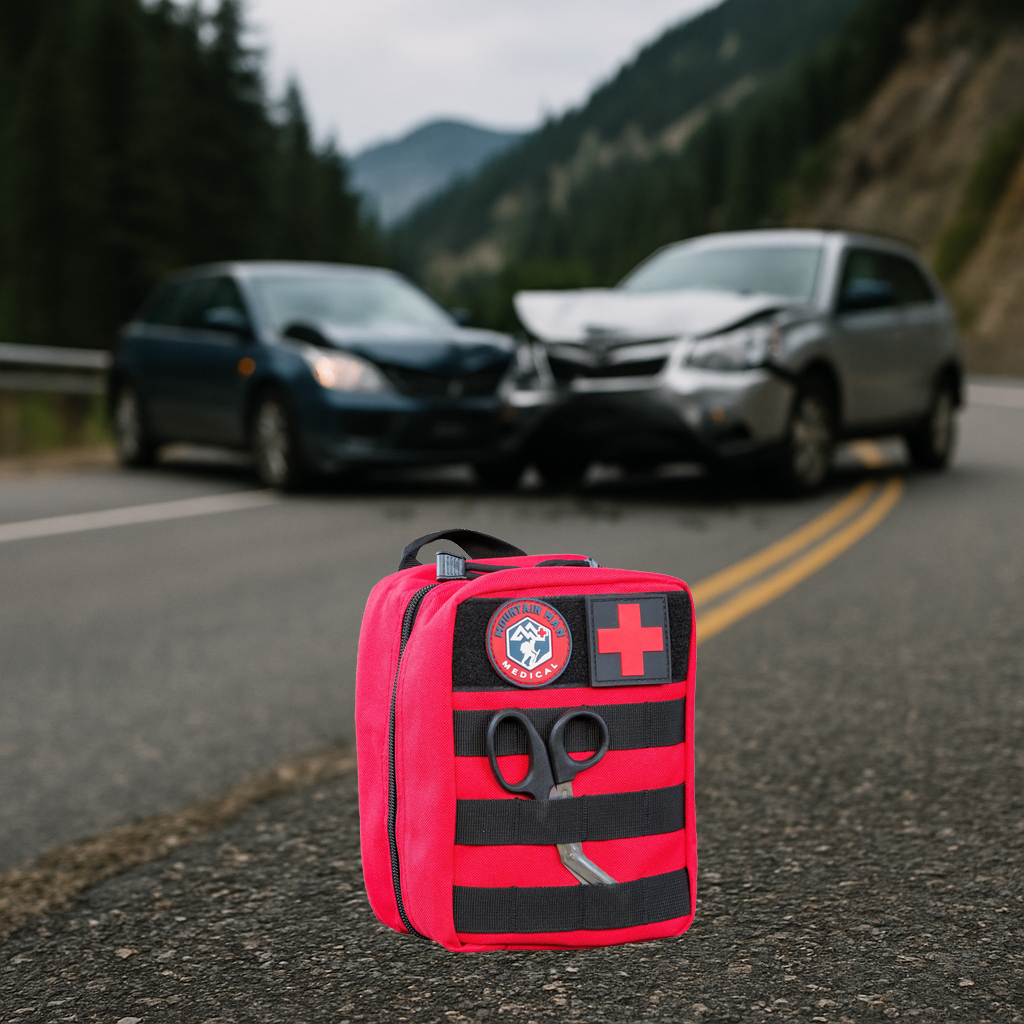
🩹 This Isn’t About Band-Aids and Neosporin
There’s nothing wrong with having a basic first aid kit. It’s great for headaches, blisters, and minor cuts.
But here at Mountain Man Medical, our focus is different—trauma kits. These are designed for the worst-case scenarios: major bleeding, crushed limbs, punctured chests.
If you—or someone you love—is bleeding out on the side of the highway, you’ll want a trauma kit within reach, not a box of ointment and gauze pads.
🧰 The Core of a Vehicle Trauma Kit
Every trauma kit worth carrying should contain four mission-critical items:
1. Tourniquet
For massive bleeding from limbs—a common outcome in high-speed crashes. Tourniquets like the CAT or SOF-T can stop arterial bleeding in seconds, buying time you can’t afford to lose.
2. Wound Packing Gauze
Used to pack junctional wounds—places where a tourniquet won’t work, like the neck, groin, or armpit. Hemostatic gauze like ChitoGauze promotes rapid clotting and can be the difference between life and death.
3. Pressure Bandage
Once you’ve packed a wound, a pressure bandage like an Israeli bandage keeps direct pressure on it, freeing your hands and stabilizing the injury during transport or while awaiting EMS.
4. Chest Seals
Crashes often result in penetrating trauma to the chest from glass, metal, or debris. Chest seals help treat sucking chest wounds, preventing lung collapse from tension pneumothorax.
These four items are about one thing: keeping someone alive long enough to reach definitive care.
🚗 Travel-Specific Additions
When you're packing for a road trip, go beyond the basics. A good vehicle trauma kit should also include:
- Mylar Blanket – Prevents hypothermia due to blood loss or exposure, and doubles as a shelter if stranded overnight.
- Trauma Shears – Cut through clothing, seatbelts, and shoes to expose injuries.
- Nitrile Gloves – For protection when treating wounds.
- CPR Mask – For safe rescue breathing if someone isn’t breathing on their own.
- Marker & Medical Tape – Useful for labeling tourniquet application time, wound locations, or notes for EMS.
🏞️ The Wind River Trauma Kit: Built for Road Travel
We designed the Wind River Trauma Kit to meet the unique demands of vehicle preparedness. It’s the same gear trusted by first responders and medics—made compact and affordable for civilians.
The Wind River Kit includes:
- A CAT-style tourniquet
- Vented chest seals
- Hemostatic gauze (ChitoGauze)
- Pressure dressing
- Mylar blanket, gloves, trauma shears, tape, marker, and more
It’s compact enough to fit in your glove box or seatback pouch, yet comprehensive enough to handle a range of serious trauma scenarios.
✅ Final Thought: You Are the First Responder
You never plan for an accident. But if you're traveling through remote country, mountains, or rural roads, you need to plan for what could happen before help arrives.
When minutes matter, you won't regret having the right gear within reach.
👉 Shop the Wind River Trauma Kit Now
Because survival isn't about luck—it’s about preparation.