
Bridging the Gap: The Story Behind Our New Bridger Compression Bandage
When we started Mountain Man Medical in early 2020, we built our kits around a simple philosophy: “don't reinvent the wheel.” The components that go into a trauma kit need to be proven, tested, and trusted by the professionals who use them when lives are on the line. That meant sourcing the best from established manufacturers — North American Rescue, TacMed Solutions, Combat Medical, and others who'd earned their reputations in the field.
So how did we end up designing a compression bandage from scratch?
This is the story of the Bridger Compression Bandage — what drove us to build it, what we learned along the way, and why we believe it's the best compact pressure dressing on the market today.
The H&H Era
Back in 2020, on day 1 of Mountain Man Medical we were stocking three pressure bandages across our IFAK lineup:
– The standard 4″ Israeli Bandage for our full-size IFAKs
– The North American Rescue Mini ETD for our mid-size kits
– The H&H Mini Compression Bandage for our Ankle IFAKs
That third one was the linchpin of our ankle kit strategy. The H&H Mini Compression Bandage was the smallest pressure-style bandage on the market at the time, and despite carrying a price point more than double its larger competitors, it was the only option that genuinely fit the footprint we needed. When you're building a trauma kit designed to ride on someone's ankle every day, every cubic inch matters. The H&H Mini was the solution — period.
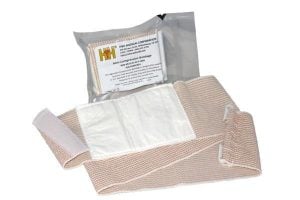
The H&H Mini Compression Bandage
It served us well for years.
The Discontinuation
Then Safeguard Medical happened.
When Safeguard rolled up a number of well-known medical supply companies into a single corporate entity, they did what corporate consolidators tend to do: they pruned the catalog. Products got streamlined, SKUs got cut, and somewhere on that chopping block was the H&H Mini Compression Bandage.
We tried to pivot. For years we evaluated alternatives — bandages marketed as “compact,” “low-profile,” or “micro.” Several would technically fit into our ankle kits, but barely. Not the clean fit we had with the H&H. We dealt with availability headaches, inconsistent supply chains, and footprint compromises we just didn't enjoy making.
Eventually we had to face the question we'd been avoiding: “should we make our own?”
The Philosophy Problem
This is where our own brand promise tripped us up. Mountain Man Medical's core philosophy has always been to source proven, name-brand components from the manufacturers who specialize in them. We carry HyFin chest seals because they work. We carry SOF-T tourniquets because they work. We don't slap our name on knock-offs and call it innovation.
So building our own pressure bandage felt like crossing a line.
That said, we already manufacture some of the more basic components in our kits — most recently our MMM IFAK Gauze, four yards of z-folded compressed gauze that goes into the majority of our kits. We had the supplier relationships. We had the technical know-how. The question wasn't, can we, — it was should we.
The answer came when we sat down and wrote out the requirements for what an ideal compact pressure bandage should look like. Once we had that list in front of us, we realized that no existing product met it. Not one. So we got samples made and started testing.
What We Learned About the Competition
Before we'd commit to our own design, we wanted to do our homework. We pulled in every compact pressure dressing we could get our hands on — including some big-name products with serious reputations — and we devised a battery of tests focused on three things:
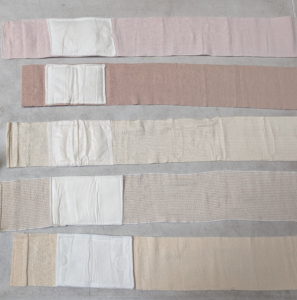
1. Absorbency of the wound pad. A pressure bandage is only as good as what it puts against the wound. Is the pad genuinely absorbent, or just a piece of fabric with a marketing claim attached?
2. Strength and effectiveness of the elastic wrap. Does it stretch evenly? Does it maintain tension? Does it tear when you cinch it down hard? Too strong and it won't stretch and apply pressure. Too weak and it becomes too stretchy and applying it is slower and more laborious, and in the end you don't get pressure. It has to be just right.
3. Reliability of the securing method. When you finish wrapping and lock it in place, does it actually stay put under movement, sweat, blood, and time?
What we found was uncomfortable. Several products we genuinely respected — from companies that have been in the trauma space for a long time — were “fine”. Just fine. Not bad. But not as good as they could be, and in some cases not as good as their marketing implied. Pads that didn't absorb the way we expected. Elastic that wasn't as strong as it needed to be. Securing mechanisms that worked, but only barely.
That changed our mission. We weren't just going to build a bandage that fit in our ankle kit. We were going to build a bandage that outperformed everything else in the compact category.
Why “Bridger”?
We named the bandage after Jim Bridger — one of the most legendary mountain men in American history.
Born in Virginia in 1804 and orphaned by age 13, Bridger headed west as a teenager and spent the next half-century carving out a life in country that killed lesser men by the season. He was a trapper, a scout, an interpreter, and an explorer. He's widely credited as the first person of European descent to see the Great Salt Lake. He guided wagon trains through passes no one else could find. He spoke multiple Native American languages fluently. He founded Fort Bridger in what's now southwestern Wyoming — a critical resupply point on the Oregon, California, and Mormon Trails.
What set Bridger apart wasn't just toughness — it was “effectiveness.” He survived, helped others survive, and got the job done in conditions that demanded both grit and competence. He was rugged because he had to be, and skilled because surviving the West required more than just being tough. That combination — rugged and effective — is exactly the spirit we wanted in this product.
There's a second meaning at work, too. A pressure dressing's job is to bridge the care of an injured party until they can reach a higher level of medical help. The Bridger is the link between the wound and the hospital. It buys time. It holds the line.
The name fits.
What Makes the Bridger Different
We'll save the technical deep-dive for a follow-up post, but here's the short version of what came out of the development process:
– The wound pad. We tested materials until we found one with measurably better absorbency than anything else in the compact category. When seconds matter and pressure has to translate into hemorrhage control, the pad makes or breaks the bandage.
– The elastic wrap. Stronger material but not too strong, more consistent stretch, better tension retention. It does what it's supposed to do — every time, no surprises.
– The securing method and tools. This is where a lot of compact bandages fall down. We engineered ours to lock in cleanly and stay locked, with a securing system we genuinely trust under real-world conditions.
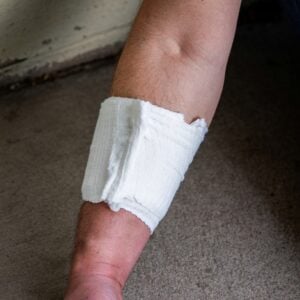
When to Reach for the Bridger
The Bridger is a compact bandage, and we want to be clear about what that means: it's designed for situations where space is genuinely limited. Ankle kits. Pocket carry. Glove box kits. Small IFAKs where every cubic inch is fought for.
If you have the space, we still recommend a full-size pressure dressing — an Israeli-style 4″ bandage, the TacMed OLAES, or another well-proven full-size design. A larger bandage gives you more pad surface area and more wrap length, and ultimately will apply more pressure if designed properly, and that matters for larger wounds and longer applications. Compact bandages are a constraint-driven solution, not a universal upgrade.
But when compact is what you need, the Bridger is what we'd reach for.
We're Proud of This One
Honestly? We're a little giddy about this release.
Five years ago we were stocking someone else's compact bandage because it was the best option we could find. Today we're shipping one we designed ourselves, tested against the market, and believe is the best compact pressure dressing available. That's a long arc, and we didn't take it lightly. Every step of the way was driven by the same question we ask of every component we put in a kit: “would I trust this to save a life I care about?”
With the Bridger, the answer is yes.
The Bridger Compression Bandage is now available on its own and as the pressure bandage component in our Ankle IFAKs and other space-constrained kits. If you carry a trauma kit — or you've been meaning to start — this is a piece of gear worth knowing about.
Welcome to the lineup, Bridger. We've been waiting for you.