
18 Recent Shark Attacks Teach One Important Lesson About Tourniquets
In July 2024, 23-year-old surfer Kai McKenzie was surfing near Port Macquarie, New South Wales, when he was attacked by a great white shark.
The injuries were catastrophic.
McKenzie's right leg was severed.
He managed to make it back to shore, but surviving the shark attack was only the beginning of the emergency. With an injury like that, uncontrolled blood loss can kill quickly.
There wasn't an ambulance waiting on the beach. There wasn't a trauma surgeon standing nearby. There was, however, another man on the beach who understood what needed to happen.
He grabbed his dog's leash and used it as an improvised tourniquet.
The man was an off-duty police officer, and the dog leash helped control McKenzie's bleeding until paramedics arrived. The rapid hemorrhage control was subsequently credited with helping save McKenzie's life.
It isn't an Australian thing either. In our little “mini research” study we found tourniquet saves with shark attack victims in Florida, California, North Carolina, New York, Texas, and Hawaii.
We Found 18 Recent Shark Attacks Where Someone Used a Tourniquet
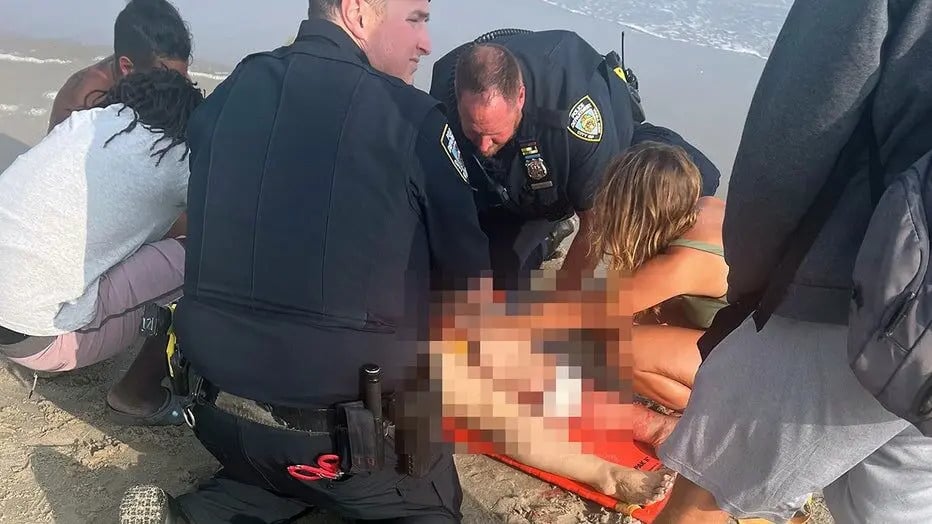
Responders treat a shark attack victim in New York. Image via fox5ny.com
Over the last few years, I've noticed what seemed like a pattern. A shark attack would make the news. The victim would suffer a serious injury to an arm or leg. And somewhere in the story would be a detail that caught my attention:
Someone applied a tourniquet.
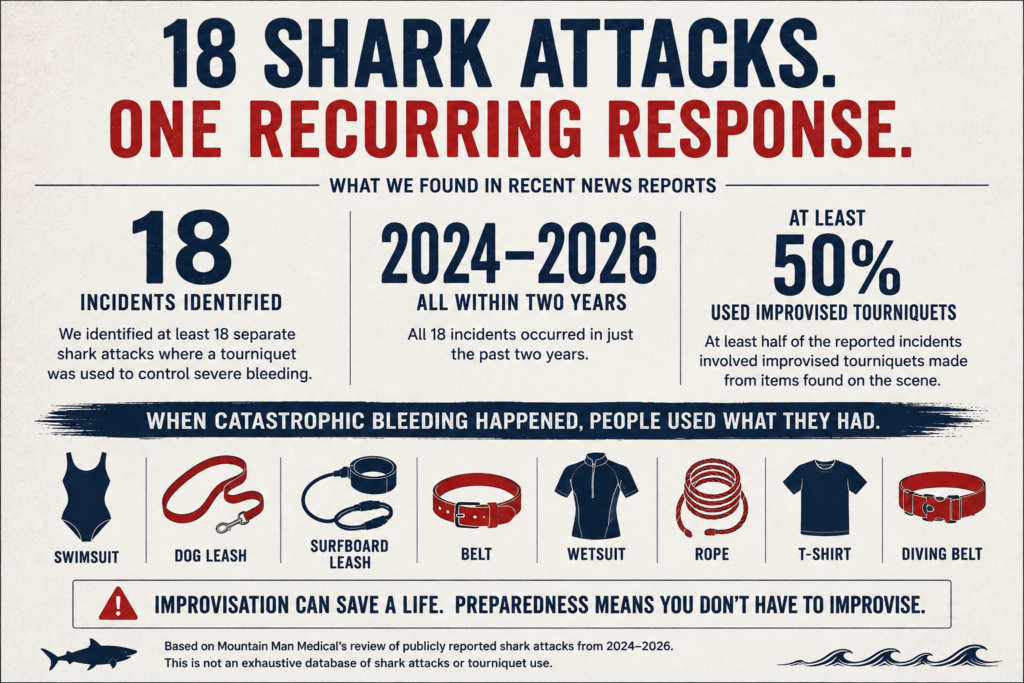
So we started looking. In our review of publicly reported shark attacks from June 2024 through 2026, we identified at least 18 separate incidents in which a tourniquet was used to control severe bleeding associated with a shark attack.
I emphasize at least.
This isn't intended to be a scientific or exhaustive database of every shark attack. News stories don't always describe the medical treatment provided at the scene, and there is no publicly searchable database that allows us to identify every shark bite in which a tourniquet was used.
There could easily be incidents we missed.
For context, the International Shark Attack File(opens in new tab) at the Florida Museum of Natural History confirmed 65 unprovoked and 29 provoked shark bites in 2025. The 10-year average for unprovoked shark bites alone is about 72 per year.
I'm not trying to calculate what percentage of all shark bites require a tourniquet. Instead what these 18 incidents give us is something different: a real-world look at what happens when people suddenly encounter catastrophic bleeding.
And the first lesson is encouraging.
A lot of people seem to understand that massive bleeding needs to be stopped.
The second lesson isn't nearly as encouraging.
A lot of them didn't have the right tool to do it.
Swimsuits, Dog Leashes, Wetsuits and Surfboard Leashes
Of the 18 incidents we identified, at least half involved a clearly reported improvised tourniquet.
People used whatever they could find.
- Swimsuits and other swimwear
- A dog leash
- A surfboard leash
- A belt
- Wetsuit material
- A diving belt
- Rope
- A T-shirt
- A speargun band
- A fillet knife used as a makeshift windlass
In one particularly remarkable case, 12-year-old Parker Roll was bitten by a shark while on a family trip in the Bahamas. His 16-year-old brother Jack recognized the severity of the bleeding, removed a swimsuit and tied it around Parker's injured leg as an improvised tourniquet.
The family was far from immediate professional medical care. Parker ultimately required major surgery and approximately 1,000 stitches, but survived. He later credited his brother with stopping the bleeding and saving his life.
That's impressive.
But the lesson isn't that a swimsuit makes a good tourniquet.
The lesson is that a teenager recognized life-threatening bleeding and did the best he could with what he had. Imagine if what he had was the correct tool.
Improvisation Is Plan B
If someone is bleeding to death and all you have is a dog leash, then use the dog leash. If all you have is a shirt, use the shirt. If you're 20 miles offshore and your friend has a catastrophic leg injury, you don't wait for the perfect piece of medical equipment to magically appear.
You solve the problem in front of you.
But successful improvisation doesn't demonstrate that purpose-built tourniquets are unnecessary. It demonstrates why you should have brought one.
A quality commercial tourniquet is engineered specifically to rapidly control life-threatening extremity hemorrhage. It provides a reliable tightening mechanism, is designed to withstand the force necessary to occlude blood flow and can remain secured while a patient is moved and transported.
An improvised device may stretch. It may loosen. It may break. It may be difficult to tighten sufficiently. And precious time may be lost simply finding materials and figuring out how to turn them into something functional.
This isn't just our opinion.
A peer-reviewed analysis of tourniquet use following animal attacks(opens in new tab) examined 50 incidents reported in the United States between 2010 and 2019. Sharks accounted for 26 of those incidents.
Researchers found that 60% of the tourniquets were improvised and 58% were applied by laypeople. The authors specifically noted that improvised tourniquets can be less effective than commercial devices and highlighted the need for better public access to proven hemorrhage-control equipment.
That research independently found almost exactly the same pattern we're seeing in these recent shark attacks. The people standing nearby know they need to stop the bleeding. They just don't always have the proper equipment available.
A Real Tourniquet Costs Less Than $35
That's what makes all of this particularly frustrating. We're not talking about a $5,000 piece of medical equipment. A proven, purpose-built tourniquet can be purchased for less than $35.
For that relatively small investment, you have a tool specifically engineered to stop life-threatening extremity bleeding quickly, effectively and reliably when every minute matters.
If you don't currently own a quality tourniquet, that's the easiest place to start.
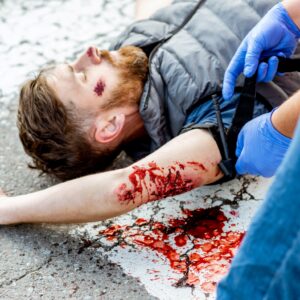
Shop Tourniquets at Mountain Man Medical
Keep one in your vehicle. Put one in your boat. Carry one in your range bag, hiking pack or emergency kit. You hope it sits there untouched for years. But when you need it, you want the real thing.
Sharks Aren't Really the Point
I live in Colorado. I'm lucky if I make it to an ocean beach once every ten years. It would therefore be pretty easy for me to read these stories and conclude that this is interesting information for surfers, divers and Australians but not particularly relevant to me.
Except sharks aren't really the point.
Catastrophic bleeding is the point.
Consider what happened at Bear Lake in July 2026. A mother of three was tubing when she was pulled underneath the boat and struck by its propeller. Both of her legs were catastrophically injured.
People on the beach immediately came to her aid and applied tourniquets while emergency help was summoned. Their actions were subsequently credited with saving her life.
She ultimately lost both legs, but she survived. No shark was involved.
If You're Going on the Water, Bring Medical Gear
We wear life jackets because people can drown. We bring sunscreen because people get burned. We carry fire extinguishers on boats because fires happen. Serious traumatic injuries should belong on that same list of risks.
Boat propellers, fishing equipment, docks, watercraft collisions, broken equipment and, yes, occasionally sharks can cause injuries where controlling blood loss becomes the immediate priority.
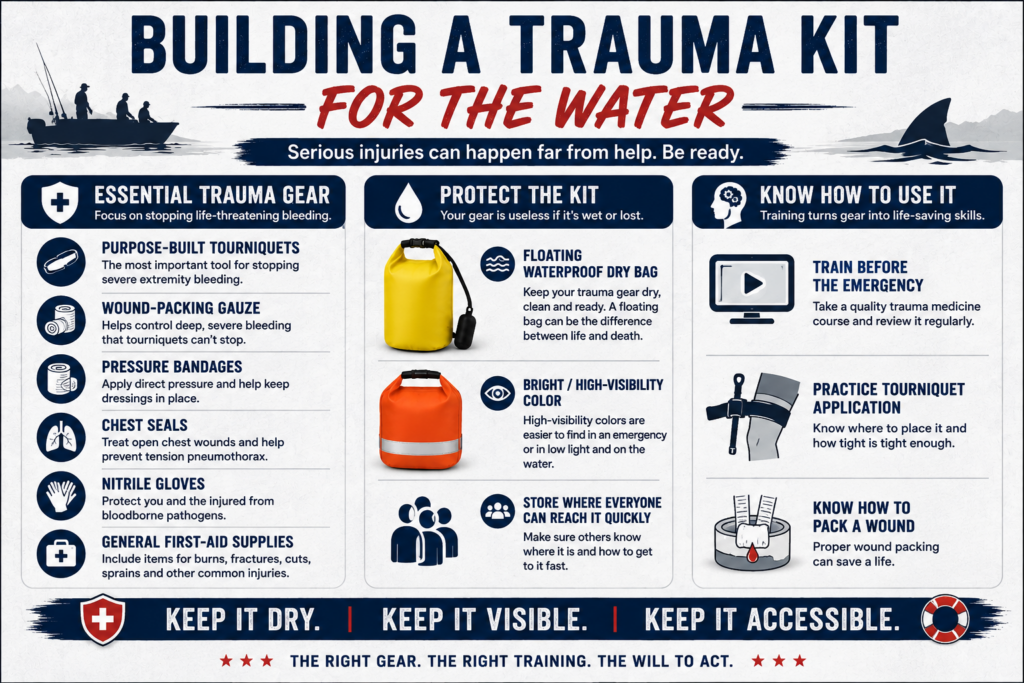
If you own a boat or regularly spend time fishing, rafting, diving, surfing or recreating around water, a proper trauma kit should be part of your equipment.
For someone who wants a compact kit focused on the major causes of preventable trauma death, our Yellowstone Trauma Kit includes a purpose-built tourniquet, hemostatic wound-packing gauze, compressed gauze, a pressure bandage and compact chest seals.
It's compact enough to carry without dedicating a huge amount of space to medical gear.
If you own a boat, regularly travel with a group or spend significant time in places where professional medical care may be farther away, I'd step up considerably. Our Wind River Trauma and First Aid Kit provides multiple tourniquets, additional bleeding-control supplies, chest seals and a much broader selection of trauma and conventional first-aid equipment.
For water use specifically, I'd also consider putting the kit inside a brightly colored floating waterproof dry bag which can be easily sourced on Amazon for less than $20.
Owning a Tourniquet Isn't Enough
There's one more lesson we shouldn't overlook. You need to know how to use this stuff. Buying a tourniquet and throwing it into your boat doesn't magically make you prepared.
You should understand how to recognize life-threatening bleeding, how to properly apply a tourniquet, how to pack a wound and how to use a pressure dressing. More importantly, you should practice those skills before someone's life depends on them.
That's why Mountain Man Medical offers our online trauma medicine training completely free. It's designed to give ordinary people the knowledge they need to respond when serious trauma happens before professional medical help arrives.
Take Mountain Man Medical's Free Trauma Medicine Training
If you're the person standing next to someone when an artery is severed, you're the first responder until someone better qualified gets there.
The Right Tool in the Right Hands
The 18 shark attacks we identified aren't proof that everyone needs to spend their life worrying about sharks. Quite the opposite. They're a reminder of how unpredictable serious trauma can be.
A teenager snorkeling on vacation.
A surfer catching a wave.
A father fishing with his son.
Friends spearfishing offshore.
A family tubing on a lake.
None of them woke up expecting to deal with catastrophic hemorrhage. Yet when it happened, people repeatedly recognized what needed to be done:
Stop the bleeding.
Sometimes they had a real tourniquet. Too often they didn't. I'm impressed by anyone who can turn a swimsuit, dog leash, surfboard leash or piece of wetsuit into lifesaving medical equipment while someone is bleeding in front of them, but I'd rather stack the odds in my favor.
Carry the right equipment. Learn how to use it. And hope you never need either.